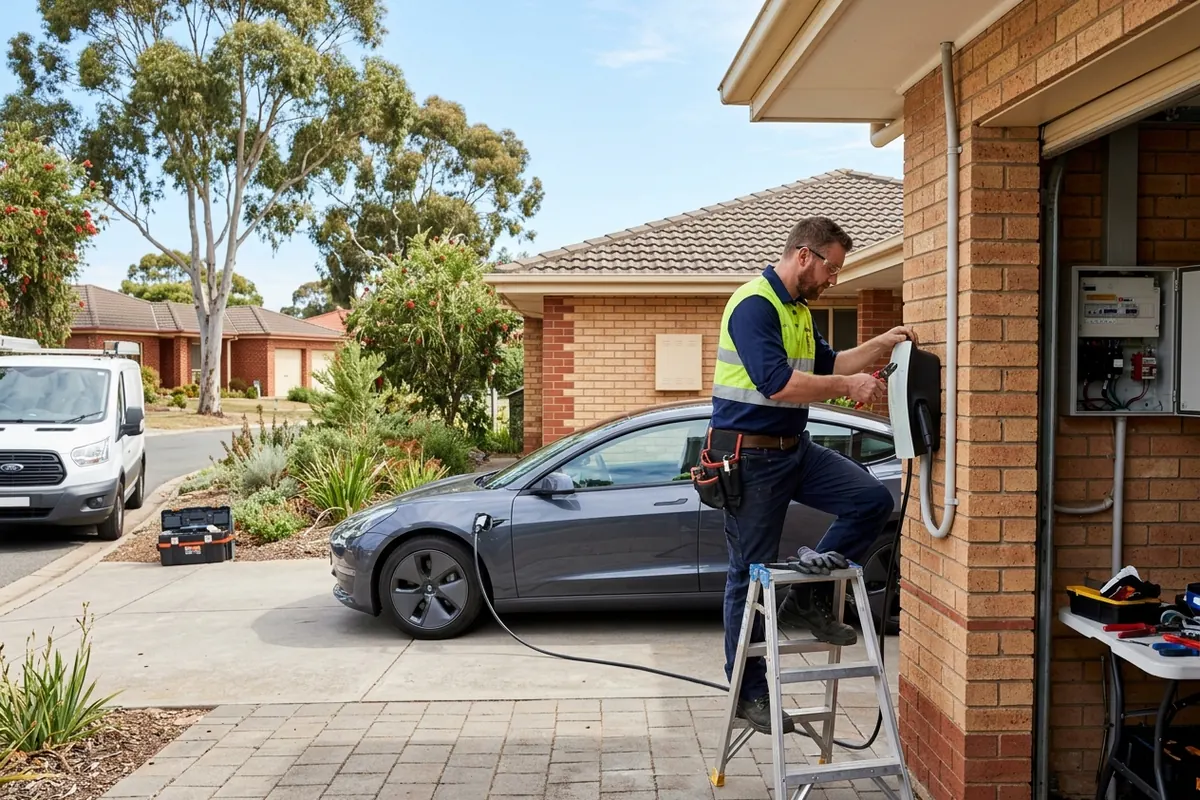
Buying an EV is the easy part. Getting it charging at home properly requires a bit of planning. Here is what an Adelaide EV charger install actually involves.
Types of home EV charger
Single-phase 7kW wall charger: most common home install. Charges a typical EV from empty in about 8 hours. Fine for overnight charging. Cost around $700 to $1,500 for the charger itself plus install.
Three-phase 22kW wall charger: faster charging, suits homes with multiple EVs or people who need quick top-ups. Requires three-phase power supply to the property. Cost around $1,500 to $2,800 for the charger plus install.
DC fast charger: very rare for home install. Big units, big cost, big power requirement. Not necessary for most home users.
What the install involves
Run a new dedicated circuit from your switchboard to the charger location. This is usually a 32A or 40A circuit on a fresh circuit breaker. If your switchboard has not got space, you might need a switchboard upgrade first.
Mount the charger on the wall, usually in the garage or carport. Connect and test.
Total time for a straightforward install: half a day to a full day.
SA Power Networks approval
For most single-phase 7kW chargers, no special approval is needed. The electrician notifies SA Power Networks but the install proceeds normally.
For three-phase 22kW chargers, SA Power Networks needs to confirm your supply can handle the load. Usually they say yes, but the application adds 1 to 3 weeks to the timeline.
For homes with solar systems already, the inverter capacity matters. You might need a slightly different setup so the solar and the charger work together.
Realistic Adelaide costs
Single-phase 7kW install with charger: $1,400 to $2,500.
Three-phase 22kW install with charger: $2,500 to $4,500.
Plus switchboard upgrade if needed: $1,400 to $2,400.
Gotchas to watch for
Some cheap chargers from overseas are not approved for Australian conditions. Stick to brands with local distribution: Schneider, ABB, Tesla Gen 3, Wallbox, Zappi.
If you are renting, get landlord permission in writing before installing. The charger usually stays with the property unless explicitly removed at end of tenancy.
If your home is older than 1990 and has not had a switchboard upgrade, factor in the cost of that work. You cannot just bolt an EV charger onto a 40 year old board.